
Agri-Food Research and Farm-Animal Care in Canada
How agri-food research is coordinated in Canada, and how national standards protect farm animals.
Agricultural research seldom reaches the front page, yet it settles much of what reaches the kitchen table. How crops are bred, how livestock are housed, and how food is checked for safety all trace back to work on experimental farms and in laboratories. We explain two connected subjects in plain terms: how agri-food research has been coordinated in Canada, and how the care of farm animals is set out in national codes of practice. For the current and binding versions, we point you to the bodies that maintain them.
Canada’s agriculture, food and seafood sector
$150B
contribution to national GDP
$100B
exports each year
2.3M
people employed
1 in 9
jobs in Canada
Source: Agriculture and Agri-Food Canada, 2026-27 Departmental Plan and sector overview.
Research and farm animal care in Canada
Canadian agri-food research is a broad field. It reaches from soil science and crop genetics through food safety and processing to the welfare of animals raised for food. A recurring problem has always been coordination. Many departments, universities, and industry groups fund and run research at the same time, so shared priorities are needed to keep effort from being repeated. Farm-animal care belongs to this field as well. It is governed by written standards that describe how animals should be housed, fed, transported, and handled, both on the farm and in transit.
The Canadian Agri-Food Research Council
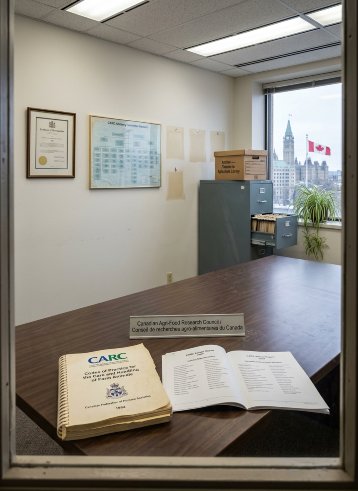
For many years, the task of agricultural research coordination fell to the Canadian Agri-Food Research Council, known as CARC, and in French as the Conseil de recherches agro-alimentaires du Canada. The Council was established in 1974 and incorporated as a non-profit in 1985. Its role was to advise on national research priorities and, from the mid-1990s, on technology transfer as well. Membership was divided close to evenly between industry on one side and universities and governments on the other, supported by a network of committees that drew in several hundred people from across the country.
One strand of that work is still cited today. From 1995, the Council took the lead, together with the Canadian Federation of Humane Societies, in revising and writing the codes of practice for the care and handling of farm animals. It coordinated that effort until about 2003. The Council later wound down, and its publications now survive mainly in archives and in references within later documents.
Who maintains the codes today
Responsibility for the codes of practice moved to the National Farm Animal Care Council, or NFACC, founded in 2005. NFACC describes itself as the national lead for codes of practice development and farm animal care in Canada. Codes now exist for close to every farmed species, and each is reviewed on roughly a ten-year cycle, so the standards keep pace with research and with public expectations.
2026 is a busy year for this work. Five codes are under revision at once, and public comment periods have opened so that producers, veterinarians, welfare groups, and the public can weigh in before the texts are finalized.
| Code | 2026 public comment period | Current version | Revised edition expected |
|---|---|---|---|
| Equine (horses and donkeys) | January 12 to March 12, 2026 | 2013 | 2027 |
| Beef cattle | April 13 to June 12, 2026 | 2013 | 2027 |
| Sheep | Update underway in 2026 | In force | To be confirmed |
Source: National Farm Animal Care Council.
The current beef cattle code dates from 2013 and replaced a 1991 version published by Agriculture Canada. The revised edition is expected in 2027. The most recent version of any code is published by the National Farm Animal Care Council at nfacc.ca.
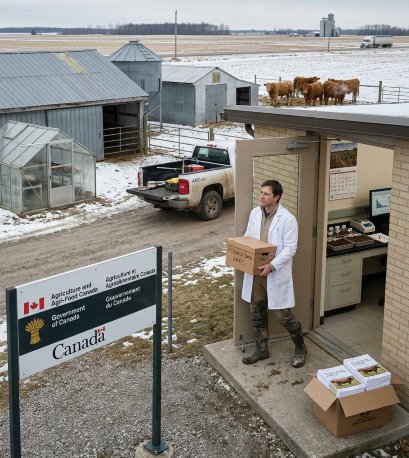
Federal research itself is carried out mainly by Agriculture and Agri-Food Canada, the department created in 1868 and still the largest agricultural research organization in the country. Its structure is changing. In January 2026, the federal government announced the closure of three research and development centres, at Guelph, Quebec City, and Lacombe, together with four satellite farms, a move that would leave the department with 17 research centres. In May 2026, the House of Commons Agriculture Committee tabled a report titled Science in Canadian Agriculture and the Closure of Research Centres and called on the government to pause and reverse the closures. The department publishes current information at agriculture.canada.ca.
Federal research in 2026
7
facilities slated to close
17
research centres remaining
665
positions reduced
Read more on the codes
The standards are worth a closer look, especially the poultry layer and veal calf codes that drew much of the earlier public attention. Start with Canada’s codes of practice for farm animals.
Frequently asked questions
The National Farm Animal Care Council (NFACC). It has led code development since 2005 and publishes the current versions at nfacc.ca.
No. This is an independent informational resource. It is not affiliated with, endorsed by, or speaking for any government department or council.
Most have been superseded. Several species codes were rewritten under NFACC after 2005, and others are being updated through 2026 and 2027. For the version that applies now, check NFACC directly.
The older texts were federal and Council publications. Many remain available through public archives and library collections, and current equivalents are kept on the NFACC site.
Its farm-animal code work moved to NFACC in 2005. Coordination of federal agri-food research now sits primarily with Agriculture and Agri-Food Canada.
Disclaimer
This page is general information only. It is not legal, veterinary, or regulatory advice, and it does not represent any government department, agency, or the former Canadian Agri-Food Research Council. Standards for farm-animal care can carry legal and market consequences, so anyone who needs the binding version should go to the National Farm Animal Care Council or the relevant federal or provincial authority. Figures are taken from public sources current as of 2026 and may change.